Polymer concrete mix design sounds simple when reduced to a sentence.
Choose a resin, add aggregate and mineral filler, mix the constituents, place the material, and allow it to cure.
That description is accurate in roughly the same way that “combine cement, aggregate, water, and admixtures” describes conventional concrete. It names the ingredients. It does not explain how to make them work together.
Replacing cement paste with a reactive polymer binder changes nearly every assumption behind conventional-concrete mix design. There is no water-cement ratio. Slump does not adequately describe the fresh material. The binder does not harden through hydration. Its viscosity, working time, wetting behavior, cure rate, shrinkage, heat generation, and final properties are connected from the moment the reactive components are combined.
The aggregate is not simply inert bulk material. Its mineralogy, particle-size distribution, surface texture, moisture condition, and packing efficiency affect how much resin the mixture needs, how it flows, how much air it traps, how it cures, and how it performs in service. Reinforcement changes the available flow paths. Section thickness changes the cure environment. A mixture that produces an excellent laboratory specimen may be difficult—or unsafe—to manufacture at production scale.
Reviews of the field consistently identify resin type, resin content, aggregate and filler selection, grading, cure conditions, and reinforcement as major performance variables. They also show how difficult it is to isolate those effects across studies because formulations and test methods vary so widely.1 2 3
Polymer-concrete mix design is therefore not the search for one ideal recipe.
It is the design of a complete material and manufacturing system.
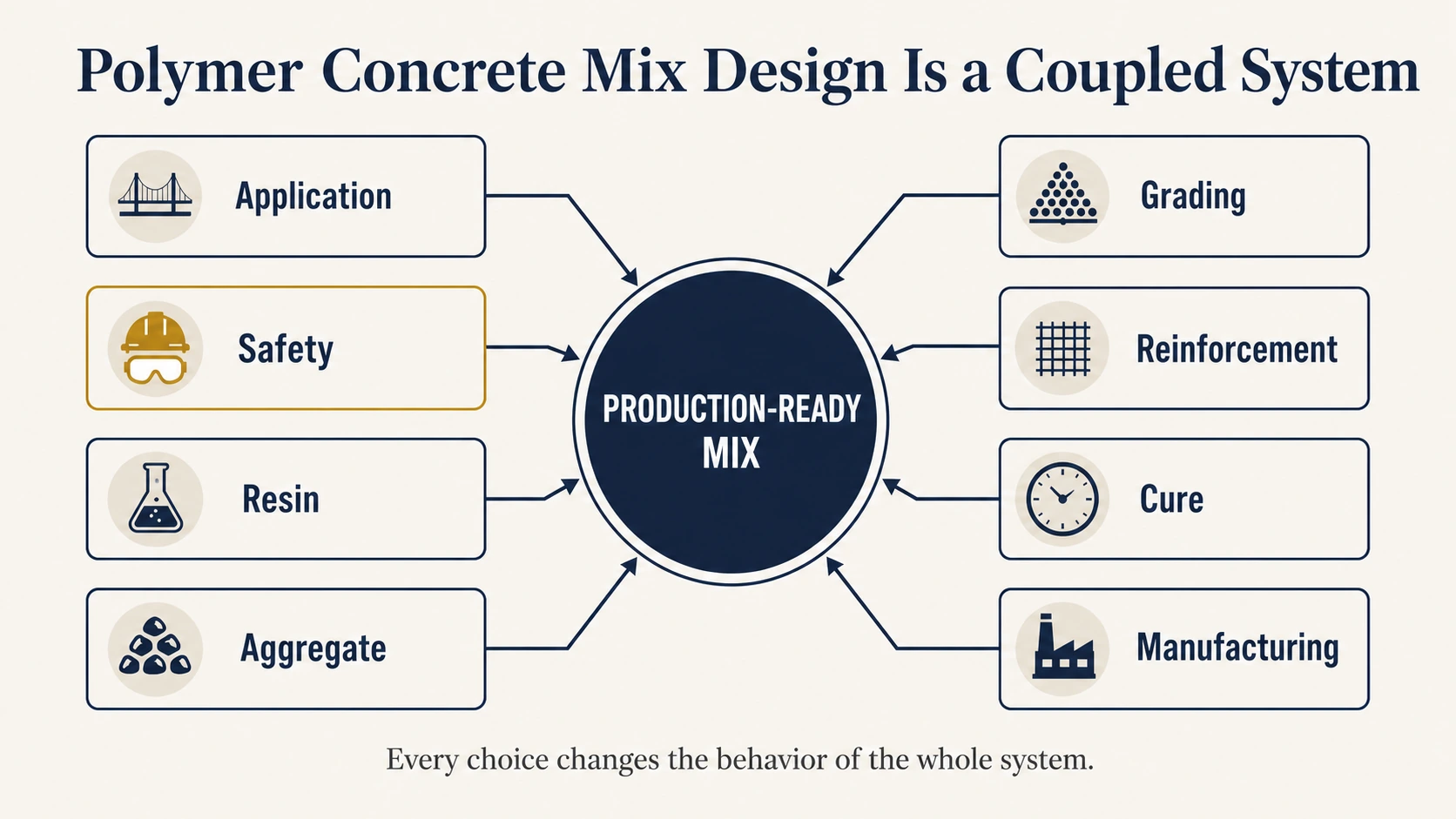
That system has to satisfy five requirements at the same time:
- Perform in the intended application.
- Remain compatible across all of its constituents.
- Flow, consolidate, and cure in the actual product geometry.
- Be manufactured safely and consistently.
- Deliver the required result at an acceptable lifecycle cost.
That is a more demanding definition of “optimal” than maximum compressive strength. It is also the definition that matters in a precast plant.
1. Begin With the Application, Not the Resin
Mix design should begin with the structure and the environment in which it will operate.
What loads must it carry? Which chemicals will contact it? Will it be continuously wet, intermittently wet, or normally dry? What temperatures will it experience? Does it need to resist abrasion, impact, or sustained loading? Is it bonded to another material? How thick is the section? How congested is the reinforcement? How much time does production need to mix and place it?
These are not questions to answer after selecting a resin. They determine which resin, aggregate, reinforcement, and production process are worth considering in the first place.
Article 03 introduced Failure Mode Engineering: identify the mechanism most likely to end a structure's useful life, then decide whether the material system can interrupt it. Mix design is where that framework becomes physical.
A wastewater structure exposed to biogenic sulfuric acid requires a chemically compatible binder and mineral system. A machine base may place greater emphasis on stiffness, dimensional stability, and vibration damping. A bonded repair material has to manage adhesion, cure shrinkage, and thermal mismatch. A thin overlay and a thick precast section may use related chemistry but experience very different heat flow and restraint.
The literature reflects those differences. Haddad and Al Kobaisi optimized a polyester polymer concrete for precision-machine bases around aggregate selection, resin content, flexural strength, and thermal expansion—not chemical exposure.4 Shen and colleagues studied glass-fiber-reinforced vinyl-ester polymer concrete under highly acidic exposure, where resin chemistry and transport resistance were central.5 Neither mixture is “better” outside the application it was designed to serve.
Safety Is an Initial Design Boundary
The production environment also belongs in the application definition.
What ventilation, dust control, storage, spill response, monitoring, training, and personal protective equipment does the plant already support? Would a candidate chemistry require specialized infrastructure beyond what a typical precast operation can reliably maintain?
At PCIC, those questions can eliminate a material option before detailed optimization begins. A technically impressive formulation may still be a poor industrial design if safe production depends on unusually burdensome controls at every facility that uses it.
The safest hazard is often the one removed during material selection rather than managed during every production shift.
That does not mean choosing the least reactive material regardless of performance. It means treating hazard reduction as a design objective alongside strength, durability, workability, and cost.
2. Select the Binder System
The binder establishes much of the mixture's chemical resistance, viscosity, wetting behavior, working time, cure mechanism, shrinkage, adhesion, creep, thermal response, and manufacturing risk.
The major resin families occupy different parts of that design space.
Unsaturated polyester is widely used for economical general-service polymer concrete. Vinyl ester is commonly selected for more chemically aggressive environments because its molecular structure contains fewer hydrolysis-susceptible ester linkages along the backbone. Epoxy is valued for adhesion, comparatively low shrinkage in many formulations, and bonded repair or specialty applications. Acrylic, polyurethane, furan, and other systems serve narrower requirements.1 3 14
Those labels are only the beginning. Two products from the same resin family can have different reactive diluents, viscosities, cure packages, temperature performance, chemical resistance, and hazard profiles.
Binder selection therefore has to consider the complete reactive system:
- Base resin chemistry
- Reactive diluents
- Initiators, accelerators, promoters, or hardeners
- Inhibitors and other additives
- Expected working time
- Heat generation and section size
- Cure shrinkage
- Service temperature and creep
- Chemical exposure
- Storage and handling requirements
- Vapor, skin-contact, fire, and reactivity hazards
Styrene illustrates why performance and safety have to be evaluated together. Styrene is an effective reactive diluent used in many polyester and vinyl-ester systems, but NIOSH identifies inhalation and skin absorption as exposure routes and classifies it as a flammable liquid with defined occupational exposure limits.7 Selecting a styrene-free binder removes that particular source of vapor, odor, flammability, and worker-exposure concern.
But styrene-free does not mean hazard-free. Replacement reactive diluents and the remainder of the cure package still require their own evaluation. Safety claims belong to specific formulations and exposure conditions, not entire resin families.
The goal is not to select the most chemically aggressive system that can be controlled. It is to select the lowest-hazard binder system that satisfies the actual application requirements.
3. Select the Aggregate and Mineral Filler
Aggregate is often described as filler because it occupies most of the mixture's volume and costs less than resin. That description badly understates its role.
Aggregate carries compressive load, contributes stiffness, controls density and thermal expansion, influences abrasion resistance, and provides most of the material's dimensional stability. Its mineral chemistry can also determine whether an otherwise resistant composite survives the intended exposure.
For acidic service, calcium-bearing aggregate can recreate a chemical target even when the binder itself is resistant. ACI's current specification for precast polymer-concrete manholes therefore requires quartz-rich, non-calcareous aggregate.8
Aggregate selection should consider:
- Mineral composition and chemical stability
- Strength, stiffness, and hardness
- Particle shape and surface texture
- Moisture and contamination
- Thermal expansion
- Density
- Abrasion resistance
- Availability and batch consistency
- Dust and material-handling burden
Mineral filler occupies the smallest particle scale, but its effects extend far beyond filling voids. It changes resin demand, viscosity, particle suspension, shrinkage, porosity, chemical transport, surface finish, and cost.
Gorninski and colleagues found that increasing fly-ash filler in polyester polymer concrete improved retained strength after chemical exposure. Their microscopy and statistical analysis connected that improvement to better packing, lower porosity, and slower penetration to the binder–aggregate interface.9 Lokuge and Aravinthan showed that fly ash interacted differently with polyester, vinyl-ester, and epoxy systems, reinforcing that a filler cannot be evaluated independently of its binder.10
The Safety Burden Can Move
Replacing resin with more mineral material can reduce cost and the quantity of reactive chemicals handled. It can also increase dust generation, bag handling, housekeeping demands, and exposure to respirable particles.
Silica aggregate deserves particular attention. OSHA's general-industry standard sets an action level of 25 micrograms of respirable crystalline silica per cubic meter of air and a permissible exposure limit of 50 micrograms per cubic meter, both as eight-hour time-weighted averages.11
That does not make silica aggregate unsuitable. It means that mineral selection, delivery form, transfer method, dustiness, and plant controls are part of mix design. A lower-resin mixture is not automatically a lower-hazard mixture if it creates a larger uncontrolled powder-handling burden.
4. Build the Particle-Size Distribution
Coarse aggregate forms the primary skeleton. Fine aggregate fills spaces between the coarse particles. Mineral filler occupies smaller voids and increases the surface area the resin must wet.
Every void remaining in that particle system ultimately contains one of two things:
Binder or air.
Efficient grading can reduce the void volume that must be filled with resin. That can lower cost, reduce cure shrinkage and thermal movement, improve dimensional stability, and increase density. Reviews of polymer-concrete formulation consistently identify aggregate grading and resin content as coupled rather than independent variables.1 3
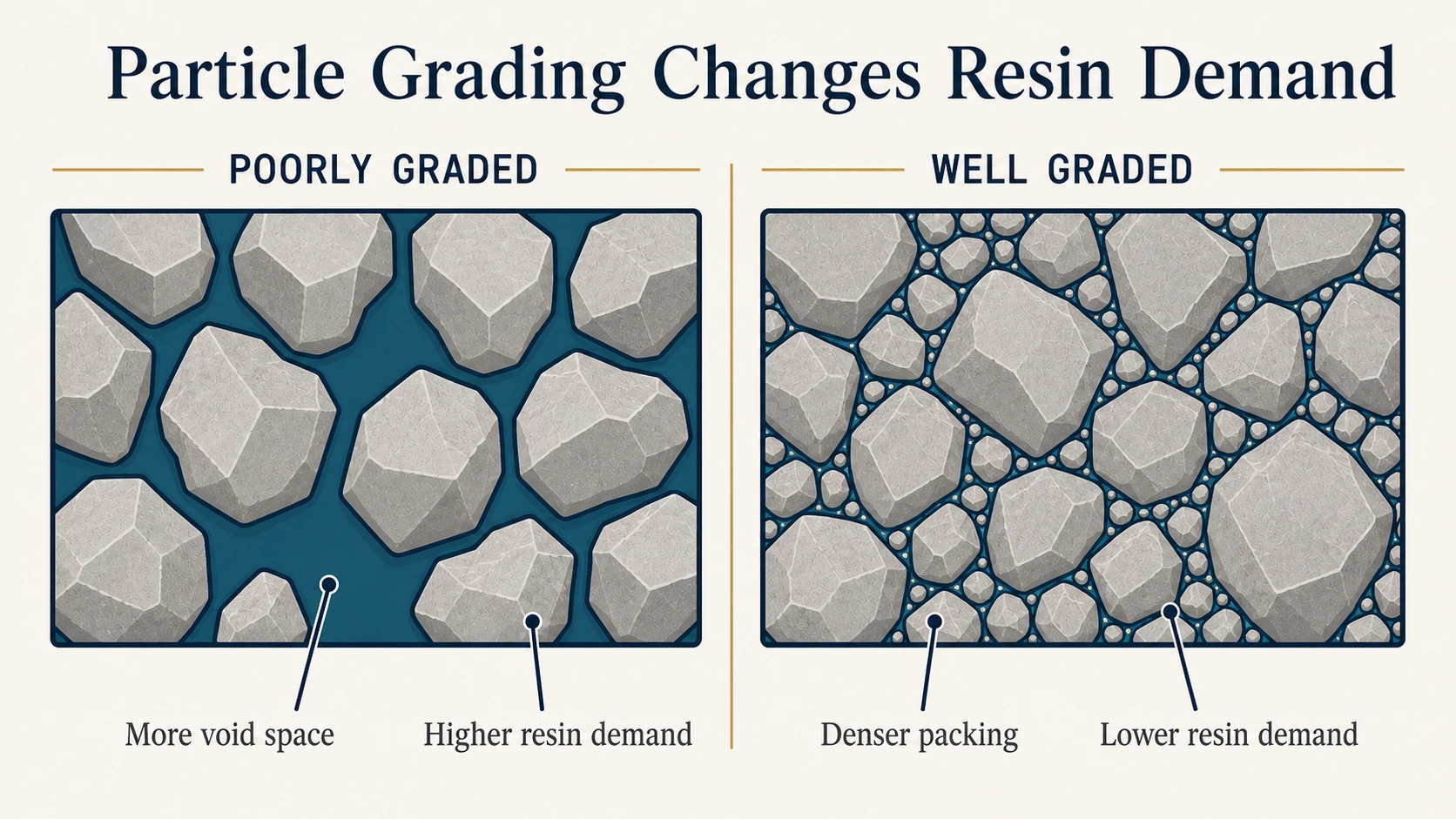
But maximum dry packing density is not a complete mix design.
The mixture still needs enough binder and mobility to wet the particles, distribute constituents uniformly, move through the mixer, pass reinforcement, fill corners and thin sections, release damaging air, and remain stable under vibration.
Packing models usually simplify or omit:
- Resin viscosity and time-dependent viscosity change
- Binder films between particles
- Surface texture and wetting
- Entrained air
- Particle movement under vibration
- Aggregate settlement
- Fiber interference
- Mixer and mold geometry
A highly packed blend may be an excellent starting point and a poor production mixture.
The practical objective is not the smallest theoretical void fraction. It is a particle system that can be wetted, mixed, placed, compacted, and cured consistently with the minimum binder required to do those jobs well.
5. Provide Enough Binder—but Not Simply More Binder
Too little binder can produce incomplete wetting, high void content, weak interfaces, poor surface finish, reduced tensile or flexural performance, and a mixture that will not fill the product geometry.
Too much binder can increase cost, cure shrinkage, exotherm, thermal movement, creep, chemical inventory, and the opportunity for aggregate settlement.
The optimum binder content is therefore not the amount that makes the mixture easiest to pour.
It is the amount that wets and binds the particle system while maintaining stability, manufacturability, and the required performance.
The literature demonstrates why one-variable rules are unreliable. Haddad and Al Kobaisi found that changing resin content altered flexural strength and thermal expansion together in a machine-base formulation.4 In another study, MMA modification increased flow and working life in polyester polymer concrete while reducing setting shrinkage, but it also reduced elastic modulus and compressive strength as dosage increased.12
“More workable,” “stronger,” and “more dimensionally stable” did not point in the same direction.
Safety complicates the balance further. Lower binder content can reduce the total quantity of reactive material, but only if the resulting mixture remains predictable. A lean mixture that demands excessive manual intervention, prolonged vibration, emergency cleaning, or repeated rework is not necessarily safer.
6. Polymer Concrete Does Not Flow Like Conventional Concrete
This is one of the easiest differences to observe and one of the hardest to describe with a single number.
Conventional fresh concrete behavior is strongly influenced by water, cement paste, admixtures, particle suspension, and hydration. Polymer concrete uses a viscous reactive binder whose properties begin changing as soon as the cure chemistry is activated.
Traditional slump intuition does not transfer cleanly.
Polymer-concrete workability depends on:
- Binder viscosity and volume
- Particle packing and total surface area
- Filler loading
- Aggregate shape and texture
- Wetting
- Temperature
- Time since activation
- Mixing history
- Vibration
- Reinforcement congestion
- Mold geometry
A mixture can appear stiff while stationary and become highly mobile under vibration. Another can appear resin-rich and fluid while permitting particle settlement, trapping air, or failing to remain uniform.
That means “flowability” is not the final question.
The useful questions are whether the mixture fills the mold, moves around reinforcement, remains uniform while moving, releases damaging voids, maintains dimensional stability, and does all of those things throughout the required production window.
Published workability data remain difficult to compare. Yeon and colleagues used flow and working-life tests to quantify the effect of MMA in one polyester system.12 Zhang and colleagues measured rheological evolution during vinyl-ester cure, but on resin rather than aggregate-filled polymer concrete.13 Those studies illuminate parts of the problem without creating a universal polymer-concrete equivalent of slump.
Workability is also a safety variable. A mixture that requires excessive manual manipulation, unpredictable last-minute placement, aggressive vibration, or difficult cleanup creates exposure opportunities even if its ingredient list looks favorable.
The safest mixture is not merely made from lower-hazard constituents. It moves through production predictably.
7. Select Reinforcement for the Failure Modes That Remain
Reinforcement should be chosen for the loads, cracking behavior, environment, and consequences of damage—not added because “fiber reinforced” sounds inherently better.
Steel bars and cages provide familiar structural behavior. FRP bars can be attractive where corrosion, weight, or electrical behavior matters, but their modulus, bond, and temperature response differ from steel. Chopped glass, basalt, synthetic, or other fibers can affect crack development, impact response, and post-cracking behavior. Continuous reinforcement serves a different purpose from dispersed fibers.
Shen and colleagues showed that a small glass-fiber addition could be incorporated into vinyl-ester polymer concrete while retaining strong acid resistance, although surface fiber exposure appeared under the most aggressive condition tested.5 Broader reviews show that fiber effects vary with fiber type, surface condition, dosage, dispersion, and binder compatibility.1 3
Reinforcement also changes the fresh mixture. Fibers increase surface area, interfere with particle movement, affect wetting, and can trap air. Bars and cages restrict flow paths and complicate inspection. A matrix that works in an unreinforced cube may not fill a reinforced production mold.
Reinforcement brings its own safety and handling considerations: sharp ends, skin irritation, airborne fragments, cutting dust, splinters, bar weight, and compatibility with existing fabrication equipment.
The reinforcement that produces the best specimen is not automatically the best industrial choice.
8. Design the Cure With the Mixture
Cure is not something that happens after mix design. It is part of mix design.
The resin chemistry, reactive diluent, cure package, constituent temperature, ambient conditions, aggregate thermal mass, section thickness, mold material, working time, and demolding requirement all participate in the same event.
Free-radical cure also creates a feedback loop:
reaction produces heat → heat accelerates reaction → faster reaction produces heat more quickly
The consequences can include shortened working time, temperature gradients, uneven conversion, increased shrinkage stress, dimensional change, and different behavior at the surface and core.
Choi and colleagues measured more than 90% of ultimate setting shrinkage within the first three hours for their vinyl-ester polymer concrete at temperatures of 32°F (0°C) and above.17 Vogt and colleagues demonstrated how strongly sustained deformation in a polyester polymer concrete increased at elevated temperature.18 Tae and Choi documented the effects of resin content and filler on shrinkage, and of filler, stress, and temperature on creep.19
A fast cure is valuable only when the mixture can be placed, consolidated, and brought through the reaction without creating new failure modes.
The cure package also carries safety implications. Initiators, accelerators, promoters, and hardeners must be evaluated for compatibility, storage, handling, and foreseeable upset conditions. A laboratory cure system that produces impressive speed but requires narrow working margins or unusually demanding controls may be a poor industrial design.
9. Make the Mixture Fit the Plant
The intended plant is one of the mixture's constituents, even though it never appears on the batch sheet.
Can the available mixer distribute the material uniformly? Can the plant meter the constituents accurately? Can the mixture be placed within the available cycle? Can it move around the reinforcement and embeds? Can workers recognize when it is drifting out of control? Can raw materials be stored correctly? Can cleanup be performed safely? Can the process remain consistent in winter and summer?
ACI SPEC-548.17-25 reflects this production-level view for circular precast polymer-concrete manholes. It requires daily compressive-strength testing, dimensional control, formulation-change retesting, chemical qualification, and a certified quality-management system.8 The standard does not treat a resin label as proof of performance. It requires the manufactured system to demonstrate it.
PCIC prefers material systems that can be implemented safely in ordinary precast manufacturing environments. When two approaches offer comparable performance, the one requiring fewer hazardous materials, less specialized infrastructure, and simpler exposure controls is generally the better industrial design.
That is not choosing safety instead of performance.
Safety, manufacturability, and performance are simultaneous requirements.
10. What a Successful Mix Design Looks Like
A mixture can achieve exceptional compressive strength and still be a poor design.
It may shrink excessively. It may have inadequate tensile strain capacity. It may cure too quickly for production, trap air, settle under vibration, generate excessive heat, creep at service temperature, require unnecessarily hazardous chemistry, or depend on equipment the intended manufacturer does not possess.
A successful polymer-concrete mixture does something more difficult:
- Interrupts the relevant service-life failure modes
- Uses compatible binder, aggregate, filler, and reinforcement
- Fills and consolidates in the actual product geometry
- Cures predictably
- Minimizes avoidable hazards
- Fits the capabilities of the intended plant
- Can be measured and reproduced
- Delivers the required performance at an acceptable lifecycle cost
No single test establishes all of those outcomes. Reaching them requires decisions across polymer chemistry, particle packing, composite mechanics, rheology, thermal behavior, structural design, production engineering, and occupational safety.
The difficulty is not that polymer-concrete mix design is mysterious. It is that the field does not yet have a mature, integrated toolkit for connecting those decisions.
11. The Mix-Design Toolkit Is Still Incomplete
Conventional concrete benefits from more than a century of accumulated methods, standards, empirical relationships, and production data. The industry has broadly understood ways to measure and discuss water-cement ratio, slump, air content, aggregate moisture, setting time, strength development, shrinkage, and statistical quality control.
Those tools are imperfect. But they create a shared language.
Polymer concrete does not yet have an equivalent mix-design system.
Modern reviews document increasingly sophisticated mechanical models and a wide range of resin and aggregate systems, while also showing that results remain difficult to generalize across formulations.2 3 A historical perspective tracing fifteen ICPIC congresses likewise describes the field's progression from empirical material modification toward modeling, simulation, and optimization.6 More than twenty-five years ago, Fowler noted that adoption lagged projections because of higher cost, contractor unfamiliarity, thermal-mismatch failures, and incomplete structural design guidance. Those barriers have narrowed in some areas but have not disappeared.15
Tests Are Borrowed From Adjacent Fields
Polymer-concrete researchers commonly adapt methods developed for hydraulic-cement concrete, plastics, neat resins, or fiber-reinforced composites.
Each captures part of the system. None fully describes an aggregate-filled reactive composite.
A conventional-concrete flow test may miss vibration-induced mobility. A neat-resin cure test excludes aggregate thermal mass, mineral surface area, restraint, and section geometry. A plastics chemical-resistance test may not reveal degradation at the binder–aggregate interface.
Polymer concrete sits between several mature technical fields without inheriting a complete mix-design toolkit from any of them.
Workability Has No Common Language
There is no broadly accepted polymer-concrete metric that simultaneously describes static stiffness, mobility under vibration, mold filling, reinforcement passability, aggregate stability, air release, wetting, and time-dependent workability loss.
Two studies can both report “flow” while measuring different behavior. Two mixtures can produce similar flow values and behave differently in a reinforced mold.
Cure Is Often Studied in the Wrong Material
DSC, DMA, rheology, and spectroscopy have produced valuable models of vinyl-ester cure and network development.13 16 But much of that foundational work studies neat resin.
A polymer-concrete casting adds aggregate thermal mass, heat conduction, restricted resin volume, mineral surfaces, air voids, reinforcement restraint, mold heat transfer, and section-size effects. A model that describes a few milligrams of resin in an instrument does not automatically predict the temperature or stress history of a full-scale casting.
Important Variables Are Commonly Confounded
Published studies frequently change resin content and aggregate content together, or filler type and filler concentration, or reactive-diluent content and total binder content. Fiber additions may displace resin. Cure temperature and duration may change at the same time. Cube strengths may be compared with cylinder strengths at different ages.
When performance changes, the responsible variable can be difficult to identify.
This is why broad claims such as “epoxy is stronger” or “more filler improves durability” deserve scrutiny. Resin family, aggregate, filler, grading, cure, specimen geometry, test age, and void content may all have changed together.
There Is No Consensus on What “Optimal” Means
One study maximizes compressive strength. Another minimizes resin content. Another optimizes flow, chemical resistance, waste utilization, or cost.
Those are legitimate objectives. They are not interchangeable.
The field still lacks a widely adopted multi-objective definition that combines mechanical performance, durability, workability, dimensional stability, cure predictability, manufacturing repeatability, safety, and lifecycle cost.
Laboratory Success Is Not Production Readiness
Most published work uses small, unreinforced specimens under controlled laboratory conditions. Far fewer studies report production-size batches, thick sections, reinforced molds, seasonal temperature variation, raw-material variability, production cycle time, reject rates, or long-term quality-control data.
The literature is increasingly capable of answering:
Can this combination of materials produce a promising specimen?
It is much less capable of answering:
Can a precast plant manufacture this product safely and consistently every day?
Why PCIC Exists
The Polymer Concrete Innovation Center was founded specifically to help close this gap.
PCIC's role is not simply to test whether a polymer-concrete specimen is strong. It is to advance the methods the industry needs: isolate variables cleanly, improve measurements of fresh and curing behavior, connect chemistry and particle packing to full-scale manufacturing, develop meaningful production controls, and translate scattered research findings into deployable material systems.
That methodological work is not separate from wider adoption. It is one of the conditions required for it. Manufacturers are more likely to invest in polymer concrete when formulation and production depend less on inherited recipes and more on measurable, explainable, transferable engineering.
Better methods also change what it means to optimize a mixture. The objective becomes larger than maximizing a property in a laboratory specimen. It becomes possible to design and verify the complete production system: how the material moves, cures, responds to variation, protects the people manufacturing it, and performs against the failure modes that matter in service.
That is the standard polymer-concrete mix design ultimately has to meet.
The best mixture is the one that places reliably, cures predictably, performs where it is needed, minimizes avoidable hazards, and can be manufactured consistently by the people and equipment that will actually make it.
References
- Bedi, R., Chandra, R., & Singh, S. P. (2013). Mechanical Properties of Polymer Concrete. Journal of Composites, 2013, Article 948745.
- Li, X., Gu, J., Xu, Y., Li, S., & Zhang, R. (2025). Review of Component Materials and Diverse Applications of Polymer Concrete. Materials, 18, 2745.
- Palamarchuk, A., Yudaev, P., & Chistyakov, E. (2024). Polymer Concretes Based on Various Resins: Modern Research and Modeling of Mechanical Properties. Journal of Composites Science, 8, 503.
- Haddad, H., & Al Kobaisi, M. (2012). Optimization of the Polymer Concrete Used for Manufacturing Bases for Precision Tool Machines. Composites Part B, 43(8), 3061–3068.
- Shen, Y., Liu, B., Lv, J., & Shen, M. (2019). Mechanical Properties and Resistance to Acid Corrosion of Polymer Concrete Incorporating Ceramsite, Fly Ash and Glass Fibers. Materials, 12(15), 2441.
- Czarnecki, L., Reda Taha, M., & Wang, R. (2018). Are Polymers Still Driving Forces in Concrete Technology? In International Congress on Polymers in Concrete (ICPIC 2018), 219–225.
- National Institute for Occupational Safety and Health. Styrene. NIOSH Pocket Guide to Chemical Hazards.
- ACI Committee 548. (2025). ACI SPEC-548.17-25: Circular Precast Polymer-Concrete Manholes — Specification. American Concrete Institute.
- Gorninski, J.P., Dal Molin, D.C., & Kazmierczak, C.S. (2007). Strength Degradation of Polymer Concrete in Acidic Environments. Cement and Concrete Composites, 29(7), 637–645.
- Lokuge, W., & Aravinthan, T. (2013). Effect of Fly Ash on the Behaviour of Polymer Concrete With Different Types of Resin. Materials & Design, 51, 175–181.
- Occupational Safety and Health Administration. Respirable Crystalline Silica Standard for General Industry and Maritime.
- Yeon, K.-S., Jin, N. J., & Yeon, J. H. (2018). Effect of Methyl Methacrylate Monomer on Properties of Unsaturated Polyester Resin-Based Polymer Concrete. In International Congress on Polymers in Concrete (ICPIC 2018), 165–171.
- Zhang, X., Bitaraf, V., Wei, S., & Guo, Z. (2014). Vinyl Ester Resin: Rheological Behaviors, Curing Kinetics, Thermomechanical, and Tensile Properties. AIChE Journal, 60(1), 266–274.
- Kumar, R. (2016). A Review on Epoxy and Polyester Based Polymer Concrete and Exploration of Polyfurfuryl Alcohol as Polymer Concrete. Journal of Polymers, 2016, Article 7249743.
- Fowler, D. W. (1999). Polymers in Concrete: A Vision for the 21st Century. Cement & Concrete Composites, 21, 449–452.
- Cook, W. D., Simon, G. P., Burchill, P. J., Lau, M., & Fitch, T. J. (1997). Curing Kinetics and Thermal Properties of Vinyl Ester Resins. Journal of Applied Polymer Science, 64(4), 769–781.
- Choi, K.-B., Min, S.-H., & Yeon, K.-S. (2016). Setting Shrinkage Characteristics of Methyl Methacrylate-Modified Vinyl Ester Polymer Concrete. American Journal of Applied Sciences, 13(5), 586–592.
- Vogt, F., Gypser, A., Kleiner, F., & Osburg, A. (2018). Polymer Concrete for a Modular Construction System: Investigation of Mechanical Properties and Bond Behaviour by Means of X-Ray CT. In International Congress on Polymers in Concrete (ICPIC 2018), 255–260.
- Tae, G. H., & Choi, E. S. (2012). Time Dependent Behavior of Polymer Concrete Using Unsaturated Polyester Resin. In Polyester, Chapter 9. InTech.